
Case study
The Value Proposition, Made Arithmetic
How a niche B2B SaaS stopped selling features and let its buyers price the problem themselves, and what that did to the first sales call.
A product cannot be bought until the buyer can price it. LAYERS sold satellite yield prediction to sugar mills, and the product worked. The problem was that its value lived in the language of the people who built it, and mills do not buy resolution, models or per parcel accuracy. They buy tons, days, and dollars per hectare.
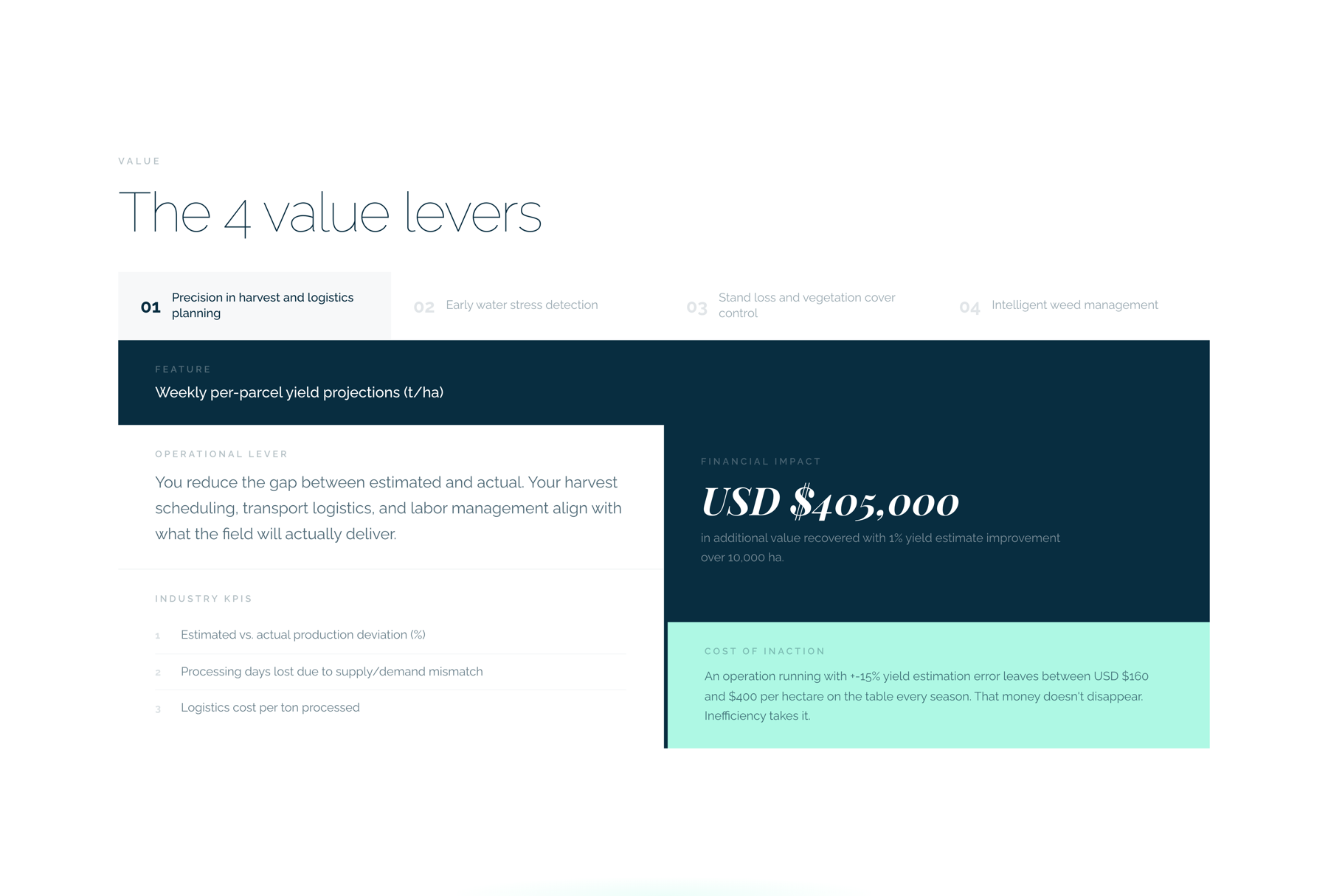
The translation was built as a chain, not a message. Every feature was carried through four steps, in the same order, and the order is the point.
Weekly per parcel yield projections, in tons per hectare. What the product does.
Harvest scheduling, transport logistics and labour align with what the field will actually deliver. What changes on Monday.
Estimated against actual production deviation. Processing days lost. Logistics cost per ton. Metrics the buyer already reports.
The value recovered by a one per cent improvement in the yield estimate, at their scale. The money.
What an operation running at plus or minus fifteen per cent estimation error leaves on the table every season. The price of the status quo.
The last step is not a document but an instrument. The same chain was published as a public calculator: the visitor sets their own crop, hectares, average yield and reference price, and the page answers with the value at stake in those numbers. A claim made by the vendor becomes arithmetic done by the buyer.
What the full case study covers
- 01 Why a good product stalls in a market that cannot price it.
- 02 The four levers, and the two decisions inside the chain that do most of the work.
- 03 From an argument the vendor makes to arithmetic the buyer does.
- 04 What changed in the pipeline, including the part most case studies leave out.
- 05 How the same system is installed in another product, in five steps.
Here it is. Twelve pages, A4, with the three exhibits from the live product.
If the case is close to your own situation, the fastest next step is fifteen minutes: book a call.